About
My Journey
A lifelong student of Japanese culture and tradition
Background
My interest in Japan began when I was young. At first, it came through books, films, martial arts, and whatever information I could find at the time. As a teenager, I studied Okinawan, or Ryūkyū, Karate and Kobudō. Later, I became interested in Aikidō, Kyūdō, Zen, and Japanese arms and armor.
In those years, I thought learning the forms and following the rules meant I understood the culture behind them. I did not. I knew enough to be interested, but not enough to recognize how much I was missing.
That realization came slowly.
In my early twenties, I had the opportunity to live and study in Japan. I attended the Yamasa Institute for Japanese Studies in Okazaki, Aichi Prefecture, and later took part in an intensive Japanese-language program connected with Doshisha University in Kyoto.
While living in Kyoto, I attended Saturday zazen at Daisen-in, a subtemple of Daitoku-ji. Ozeki Sōen Roshi was there during that period. I was not one of his formal students, and I do not want to suggest that I was. I was simply someone who attended, listened, practiced, and tried to understand what was being taught.
Much of it went over my head at the time.
Even so, the experience stayed with me. I began to understand that attention is not limited to what happens during formal practice. It also appears in how a person enters a room, listens to another person, handles an object, responds to correction, or recognizes when it is better not to speak.
Two Japanese expressions helped me understand this.
The first is deru kui wa utareru, often translated as "the nail that sticks up gets hammered." The second is kūki o yomu, or "reading the air." Someone who fails to notice the mood or expectations of a situation may be described as kūki ga yomenai.
For someone raised outside Japan, reading the air can be hard. It cannot be learned by memorizing bows, greetings, or set phrases. Those things matter, but they are only part of it. The rest comes from watching, listening, making mistakes, and noticing how other people respond.
I made plenty of mistakes. I still do.
In martial arts, Zen, tea, and other forms of practice, I gradually learned that effort does not always need to be announced. Knowledge does not need to be displayed at every opportunity. Sometimes the work is to listen, follow the form, accept correction, and continue.
One of my teachers once told me that foreigners sometimes focus so much on the visible parts of etiquette that they overlook what the etiquette is meant to protect. A bow can be performed correctly while the person performing it remains unaware of everyone around them. The words may be right, but the timing may be wrong.
I wish I could say I understood this immediately. I did not.
After studying in Aichi and Kyoto, I moved to Ochanomizu in Tokyo. I lived in a small apartment and worked for a Japanese couple who operated a restaurant in the Tokyo Family Hotel, near the Holy Resurrection Cathedral, better known as Nikorai-dō. I remained in Japan for about two more years before returning to the United States.
Those years shaped much of how I see Japan now. They were also confusing at times. I was interested in many things and often moved from one subject to another, trying to find the connection between them.
Some of that was part of being young. I spent time studying language and culture, but I also spent more time than I should have in internet cafés, watching animation and playing video games. Probably more money than I should have, too.
Looking back, I do not see those years as a straight path. They were a collection of experiences, mistakes, friendships, lessons, and moments that I did not always understand until much later.
My Tea Background
My first experience with Chanoyu came through Urasenke while I was living in Japan. The wife of my host family, Inoue Sensei, practiced tea and allowed me to observe and participate.
At the time, I did not understand much of what I was seeing. I noticed the movements, utensils, sweets, flowers, and arrangement of the room, but I did not yet understand how they worked together. I thought tea was mostly about performing each step correctly. Well, I probably thought that about many things then.
What stayed with me was the way the guest was received. Nothing appeared rushed, yet everything had a place. The season mattered. The utensils mattered. The condition of the room mattered. Most of all, the people in the room mattered.
Many years passed before I began studying tea in a regular way. I started formal practice in 2013 and have continued since then. I am grateful for the guidance I have received from Takako Hori Sensei, John Larissou Sensei, and the teachers and senior students who have corrected me along the way.
Tea has brought together many of the things that first drew me toward Japan: movement, timing, hospitality, season, preparation, and the relationship between teacher and student.
It has also shown me how little can be rushed.
A person may learn the order of a procedure, but that does not mean the procedure has become part of them. That takes repetition. It takes correction, and then more correction. On some days, a movement begins to feel natural. On another day, the same movement falls apart for no clear reason.
That is part of the practice.
I do not present myself as an authority on Chanoyu. I remain a student and expect to remain one. Anything I share comes from what others have taken the time to teach me, and I try to be careful not to present borrowed knowledge as my own achievement.
I currently live in Washington with my wife, Yoko. I continue to practice Chanoyu at Omotesenke Yoku'an, the chashitsu built in our home. I also continue my study of Kyūdō under Stephen Scott Sensei, Kyūdō Renshi Rokudan.
On Monday and Wednesday mornings, I host zazen in our tea room. The gathering is small and the format is uncomplicated. We sit, practice, and try not to make more of it than it is.
Those in the Snohomish area who have an interest in Tea Ceremony or zazen are welcome to contact us about visiting our study group. We are not establishing ourselves as masters or building an institution. We are students trying to provide a place where people can practice, learn, and spend time with these traditions.
I continue to make mistakes, misunderstand situations, and discover things I thought I already knew. That has not discouraged me. It has become one of the reasons I continue.
"Each day in life is training,
Training for myself.
Though failure is possible,
Living each moment,
Equal to anything,
Ready for everything.
I am alive — I am this moment.
My future is here and now.
For if I cannot endure today,
When and where will I?"
— Sōen Ozeki, Words for Each Day, Daisen-in Zen Temple, Kyoto
Key Locations — Japan
Interactive MapGallery
Photographs
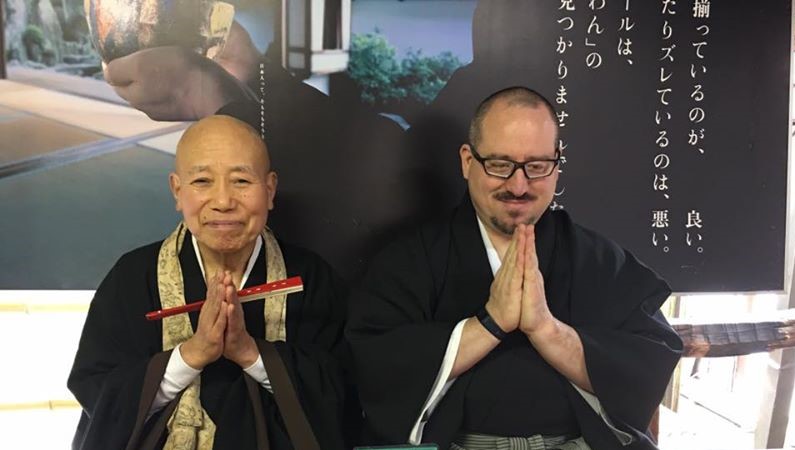
Ozeki Sōen Sensei (2016)
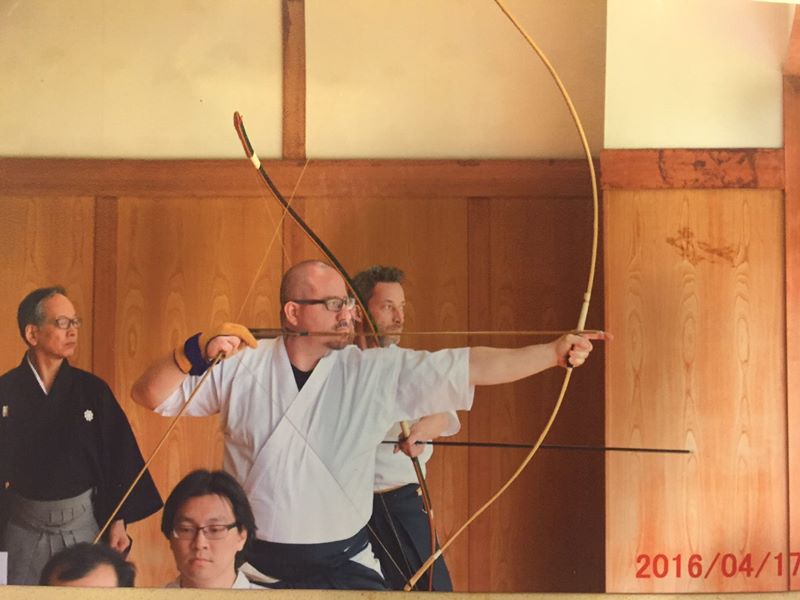
Nidan Shinsa, Nagoya, Japan (April 2016)
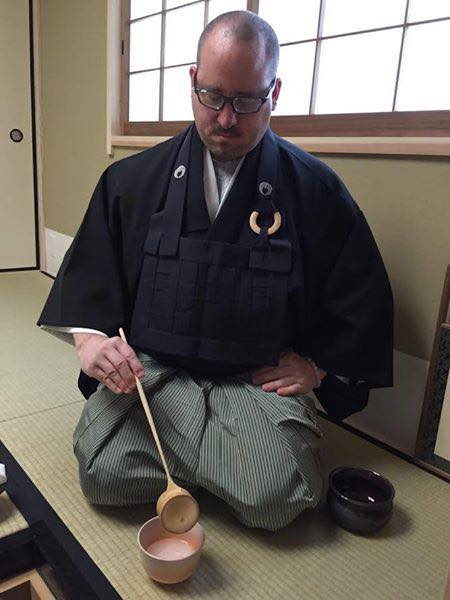
Tea Practice (2014)
Ozeki Sōen Sensei (2016)
Nidan Shinsa, Nagoya, Japan (April 2016)
Tea Practice (2014)
Interests
Hobbies
Newsletter
Occasional Updates from the Pacific Northwest
Infrequent notes on traditional Japanese culture events, tea practice, and resources — sent only when there is something worth sharing.